Dental Implants in Woodville
A titanium post placed in the jaw to support a replacement tooth. Here’s how the process works, what it involves, and how to judge whether it’s the right option for you.
What a dental implant is
An implant replaces the root of a missing tooth. A small titanium post is placed into the jawbone, left to integrate with the bone over a period of months, and then restored with a crown on top. The result is a replacement tooth that stands on its own, without altering or relying on the teeth either side of it.
Implants can replace a single tooth, several teeth, or be used to secure a denture that has never sat comfortably. Dr Anthony Vinci has undertaken postgraduate implant training through gIDE, and implant dentistry is a particular interest of his.
Who implants suit
The best candidates have healthy gums, enough bone at the site to hold an implant, and general health that supports healing. None of those are absolutes — bone can sometimes be augmented, gum disease can be treated first, and plenty of people who assume they aren’t candidates turn out to be. Equally, some people are better served by a bridge or a denture, and we’ll say so.
What matters most is that the decision is made after an assessment rather than from a brochure.
How the process works
Assessment. An examination, X-rays and usually a 3D scan, so we can see the bone volume and the position of nearby structures before anything is planned.
Planning. We map out where the implant needs to sit to give the best result, and talk through the timeline, the costs and the alternatives.
Placement. The implant is placed under local anaesthetic. Most people are surprised by how straightforward the appointment is, and many find it easier than an extraction.
Healing. The implant integrates with the bone over roughly three to six months, depending on the site and your healing. You won’t be left with a gap in a visible area during this time.
Restoration. Once integration is confirmed, an abutment and crown are fitted. The crown is made to match your own teeth in shape and colour.


Risks and things to consider
Implant placement is minor surgery, and it carries the usual risks of any surgical procedure: bleeding, swelling, bruising and infection. Specific to implants, there is a risk that the implant does not integrate with the bone and has to be removed and replaced, and — depending on the site — a small risk of injury to nearby nerves or the sinus.
Smoking, uncontrolled diabetes and untreated gum disease all reduce the likelihood of success. Heavy grinding puts extra load on the restoration, and if you grind we’ll usually recommend a night splint to protect it. Implants also need looking after: they can’t decay, but the gum and bone around them can become inflamed and recede if they aren’t cleaned properly, so ongoing maintenance matters.
We’ll explain the specific risks in your case, and the alternatives — including doing nothing — before you decide.
How long implants last
Many implants last for decades with good care and regular reviews. Like natural teeth, they depend on healthy gum and bone around them, so their longevity has as much to do with maintenance as with the implant itself. The crown on top is a restoration like any other and may need replacing at some point over a long lifespan.
What implants cost
We don’t publish set fees, because implant treatment varies so much between people — the number of implants, whether bone grafting is needed, and the type of restoration all change the picture. After your assessment you’ll receive an itemised written quote with dental item numbers, so your health fund can tell you exactly what it contributes before you commit. Where treatment can be safely staged, we can plan it across calendar years so two years of annual limits can be used.
A safe and effective procedure
Dental implants are safe and effective provided the surgery is done by a well trained & experienced dental surgeon.
The surgical procedure may be completed In one appointment or over the course of multiple appointments depending on the needs of the patient. At Adelaide Dental Solutions we use 3D scanning technology to perform Guided Implant Surgery, which is more accurate and predictable.
- Digital scans and radiographs are taken in order to accurately plan the surgery.
- A 3D printed guide is then produced to facilitate a high level of accuracy.
- The implant is placed in the desired position in the bone to ensure optimal function, health & aesthetics.
- Once we have determined the implant is sufficiently integrated into the bone and the soft tissues are healed we will plan for the final restoration (tooth)
- Finally we optimise the soft tissue (gums) and then we attach the tooth to the implant.
- Regular maintenance and review is crucial for the long term prognosis of the implant supported tooth.
Why speak to us about dental implants?
Solution Best Suited To You
Caring And Experienced Team
Our practice in Woodville South
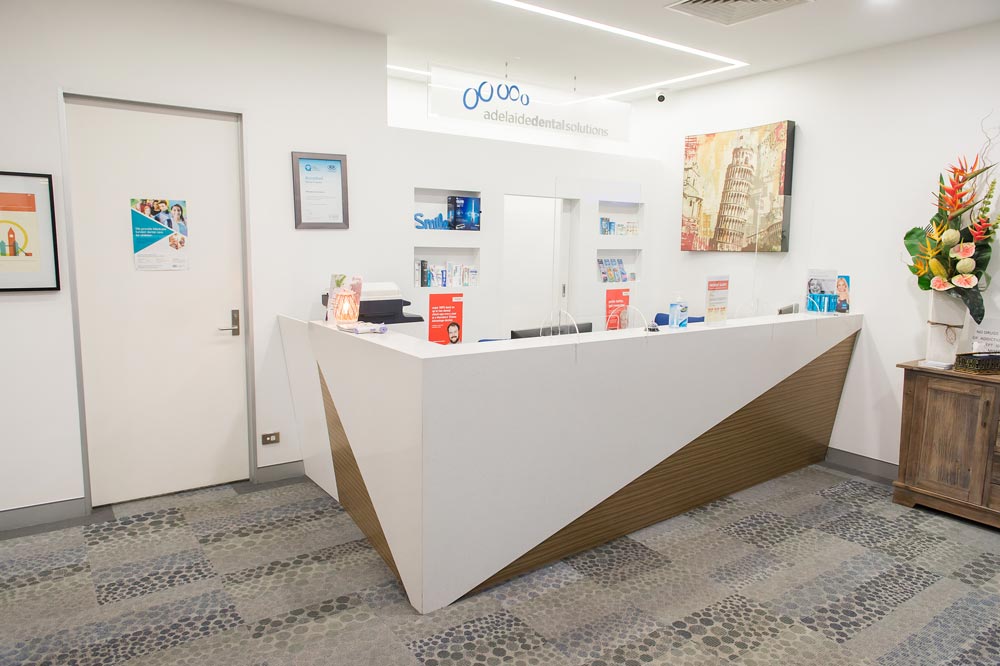
Adelaide Dental Solutions is at Suite 1, 850 Port Rd, Woodville South — in the same precinct as the Queen Elizabeth Hospital, with parking on site.
Frequently Asked Questions
How long can I wait before getting a dental implant?
How long does the procedure take?
How long do dental implants last?
What are the risks?
Is it painful?
Am I too old for a dental implant?
What are the alternatives to an implant?
Will my health fund cover an implant?
In pain now?
Visit us at Suite 1, 850 Port Rd, Woodville South. We'll give you honest advice about what can wait and what can't, and a clear written quote before any treatment begins.
Our practice in Woodville South
Adelaide Dental Solutions is at Suite 1, 850 Port Rd, Woodville South — in the same precinct as the Queen Elizabeth Hospital, with parking on site.